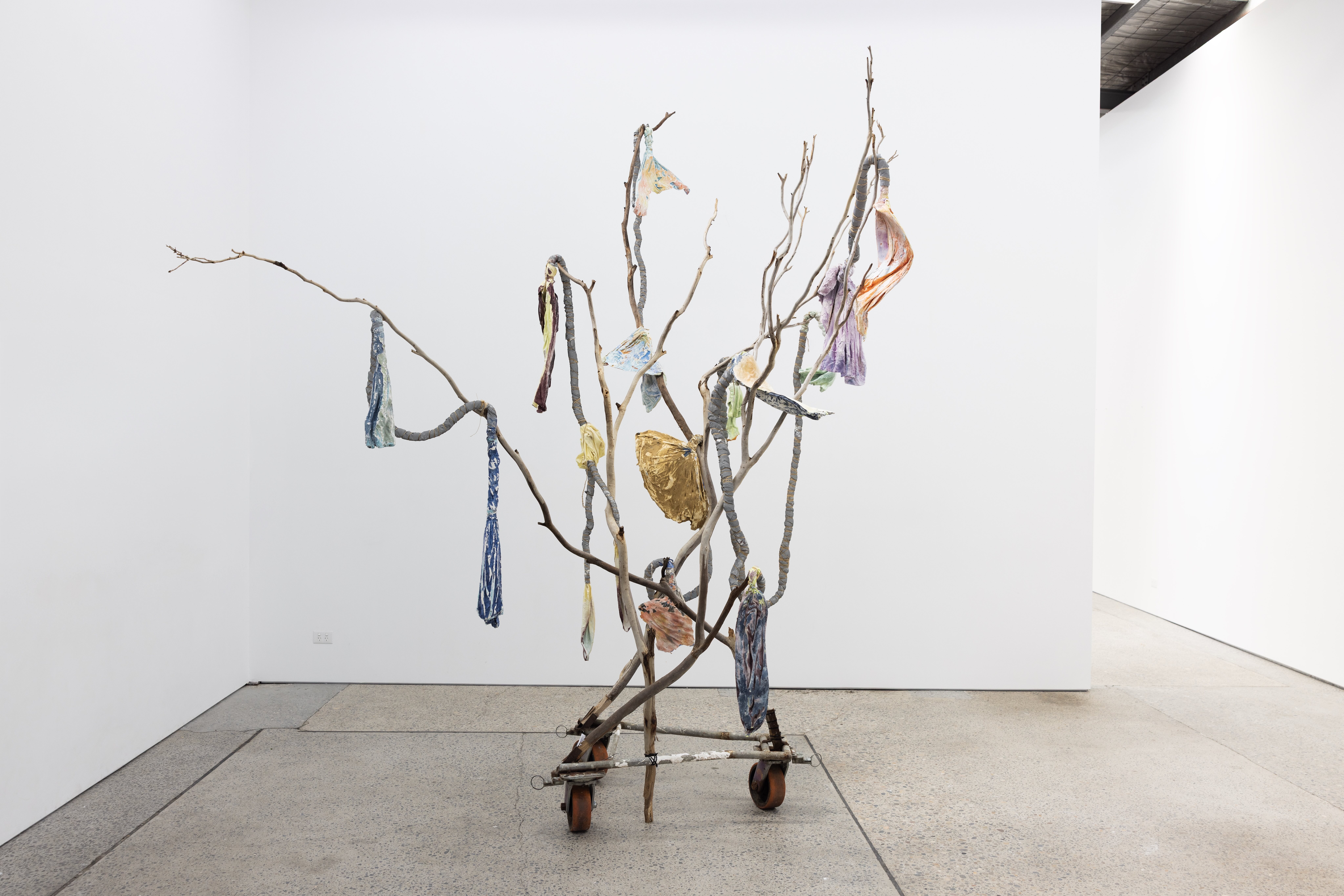
COMA is pleased to present a solo exhibition by Australian artist Shan
Turner-Carroll (b.1987), titled Bless You, Bless Me, Bless the Mountain, on view from 6 March - 4 April, 2026 at 37 Chapel Street, Marrickville, Sydney, NSW, 2204.
The sun’s light does not discriminate, words by Sophie O’Brien
Shan Turner-Carroll has often explored the transmission of energy between the human and natural worlds, his work encompassing photography, sculpture and installation, and the performative. The relationships between all these elements – both in content and in form – are often tightly interwoven, albeit makeshift. Photographic documentation can shapeshift into portraiture, ritual clothing transforms into sculpture, performative action turns into a form of landscape painting.
For Bless You, Bless Me, Bless the Mountain, Turner-Carroll returned to his family home on Wonarrua Country, creating an outdoor studio facing the Broken Back Mountain Ranges. Working on a large scale, the artist gathered both natural and artificial materials to build sculptural constructions that lean further into an exploration of materiality and abstraction. Intentionally stepping away from language, out of the theoretical and into the material, the artist chose to make in a space with which he held a long-term physical bond – the place where he grew up. This allowed him to create a looser framework for making, where ideas could be drawn from material experiments in the natural landscape, and the polemics of nature versus culture could be more easily muddied. The trees he knew well from his childhood could become close collaborators, along with the family and friends who often join with Turner-Carroll to realise projects.
Turner-Carroll’s temporary monuments, playful and philosophical in nature, rest in soft sympathy with their natural surroundings. They appear out of the darkness, bulky yet delicate, displaying grandeur and clumsiness in equal measure, as if formed through a ritual or unnamed need. Overtly hand constructed, their original purpose – if there was one - is unknown; the darkness lends them release from any task they were required to perform. Propped by branches and somewhat insufficiently tensioned by ropes, the sculptures may be evolving or collapsing. Under our scrutiny, they stop still in the light, pausing as an animal might on a night-time country road, held by the glare.
Turner-Carroll describes these photographed sculptures as embodied gestures of prayer, but the missive to a potential divine is not locked only in the physical form; it is primarily located in the action of making. Although shrine-like, the sculptures are less an offering – rather they appear to be otherworldly protagonists that the artist has discovered. These complex, seemingly gentle-natured forms – manifested through the artist’s labour and now shaped by light in the dark night – are made mysterious. They might be ancient or new.
Alongside the photographs of Turner-Carroll’s co-conspiring trees, basketballs and hay bales, sits an installation of wooden, painted discs. Hope lies intrinsic to its making and its architecture: it promises that the physical world can be refashioned, colour fades yet can become new, component parts can interlock in new ways – that is, that all things are surely relational and each holds a potential for transformation. This proposal suggests that careful and tender action can be a petition for change, and that invoking the unknown has the power to build a language between me, you and the mountain.


